Friday, September 28, 2012

Beans and Peas


Spring has sprung and the pulses are pulsing. My sweetpeas have turned triffid and blocked off an entire pathway but they seem reluctant to flower. I've begged my neighbours to be patient and put up with the inconvenience as there's no way I can contain them, they're, quite literally, a force of nature. I've promised they can pick the flowers to their heart's content... as soon as they finally begin to bloom. At least there a buds...


I'm experimenting with scarlet flowering broad beans this year and they are LOVELY! If they crop as well as regular broad beans I don't think I'll ever plant the ordinary ones again.


Friday, April 20, 2012

High Density Dreaming


I work in Preston and I ride through Comas Hill every weekday on my way to and from school. I have to say, I've been surprised to see the sentiment, "Halt the Highrise" being expressed in an area that I've always imagined to be more environmentally and socially conscious than most. Black and white signs emblazoned with this slogan are posted in the shop windows and on almost every fence I pedal past. My concern and curiosity prompted me to check the website to see exactly what it is that's upsetting so many residents. And from what I can see, the community is objecting to a small number of medium density housing developments on the basis that they are "out of character" with the local neighbourhood. 

I found this objection concerning.  Surely, in order to create a sustainable future for our country (and our planet), the character of our neighbourhoods needs to change, and it needn't be for the worse. Big houses with big backyards, are not, and cannot be for everyone. Low density housing for the masses means cities that sprawl over the horizon, chewing up countryside and bushland and necessitating ever-lengthening roads to carry residents of far flung suburbs in and out of the CBD each morning and afternoon. The other option, the option our planet's future depends on, is the option that provides medium and high density housing in the inner city. This will keep our cities compact and give more people the option to live in happening inner-city suburbs like Thornbury, close to the city (where many of them work), within a walk or a bike ride to services and amenities like council pools, libraries, public transport, markets and, of course, good coffee.

In an effort to understand where the residents of Comas Hill were coming from I tried putting myself in their shoes. Perhaps, I thought, I’d feel differently if my peaceful, parkland neighbourhood was being threatened by a number of four storey, medium density housing developments. And then I pictured my street – the row of tightly packed townhouses, the three storey flats at the top of the hill and two more blocks of four storey apartments at the bottom of the hill along Harrison Street. 

Sure, they’re not an attractive bunch of buildings, nor do they carry particularly good environmental credentials. They do however contain a great bunch of people, neighbours and friends, who talk to each other and care about each other. The more I thought about it, the more I realised, that despite its medium density housing, my little corner of East Brunswick has a whole lot of character and a sense of neighbourhoodiness that would put Ramsey Street to shame. Here in Merri Corner we stop and chat in the street, we collect each other’s mail and water plants when someone is on holiday, we’ve exchanged spare keys and homemade jam; the boys who used to live next door would walk the dog and I used to pop over for a beer and a chat after work. The couple on the other side dropped over not one but two batches of homemade hot cross buns for Easter and it’s definitely our turn to have them over for dinner. When it comes to community, we are living the dream.

This sense of community has always existed but it’s even more evident now that the garden has come along. In fact, I suspect that the relatively high density of people living in my neighbourhood is the very thing that made our community garden possible. So many of us, in such a small area, without backyards in which to grow our veggies gave the project enough impetus to push through the tiresome process of council approval and grant applications  and blossom into reality. It works because so many of us are just around the corner from the garden, we can pop down after work to do some weeding and turn the compost or drop into each other’s houses to plan the latest project over a cuppa.

Perhaps there is an objectionable aspect to the Comas Hill developments that hasn't been made clear on the protest website. But higher density housing in and of itself needn't be a bad thing. Rather than campaigning against new developments altogether, surely it makes more sense to put your energy into lobbying to make sure that developers produce beautiful and environmentally sound buildings which are in character with the surrounding suburbs and that councils plan for an increase in the local population. Thornbury is a beautiful suburb with a strong sense of community. Rather than viewing any change as for the worse, why not work together to make it change for the even better.

Tuesday, February 21, 2012

Bloomin' Delicious

"Am I the only gardener who grows zucchini for their flowers, not their fruit? I hope not."

Indira Niadoo, The Edible Balcony.


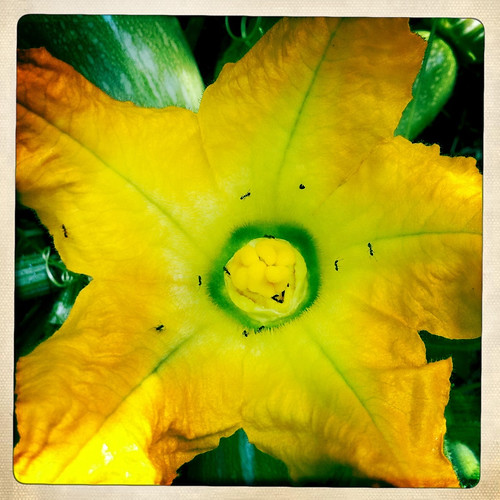
Step 1: Pick flowers. Wash and remove stamens from inside.
From the earliest age and right up into the present, I've always been less than ambivalent about the fruit of the Cucurbit family. Actually, that's not true. Melons and cucumbers I'm pretty happy about but zucchini, pumpkin and squash leave me less than cold. (Don't even get me started on choko.) I quite clearly remember, genuinely gagging and retching as a child when my parents tried to force me to eat roast pumpkin. And whilst I can eat it now without the urge to hurl, I'm still not all that keen on the stuff.

Zucchini, however, are my pet hate. Sure they're easy to grow but they taste bloody awful - how the damn things manage to taste simultaneously bland and utterly nasty has to be one of life's great paradoxes. Last summer was a bumper zucchini year and in the garden there was a glut of zucchini in almost every plot (bar mine). The place was overflowing with prickly plants that were prolific to the point of tiresome. Even those who loved them eventually tired of zucchini slice and in the end people couldn't give the snot-flavoured things away. They were left to bloat to massive size on the rampant vines before being thrown into the compost to rot.

Step 2: Mix Danish fetta, pesto, chopped capers and pepper.
This year people were a little more conservative with their cucurbit plantings, but there were still a considerable number of pumpkin, zuch and squash put into the communal beds. Whilst the pumpkins were spreading their prickle-covered umbrella-sized leaves beneath the fruit trees and the zuch were doing their best to colonize the potato beds, I was travelling through out Mexico for my brother's wedding. And in Mexico, I discovered the one true reason to grow zucchini and their kin - the flowers! I'd tasted (and enjoyed) squash flowers before but I'd always seen them as something of a fancy, fussy, novelty delicacy. However, in Mexico, I discovered that squash and zucchini flowers, or flor de calabaza, are a produce in their own right. Stuffed with cheese, crumbed and fried they appear on most cantina menus, while sauteed they are on offer as a taco filling at the stalls of all good street vendors. And unlike their fruiting bodies, they are freakin' delicious!

Step 3: Stuff flowers then dip into flour, beaten egg, breadcrumbs.
Almost as long standing as my dislike of zucchini, is my crush on the ABC newsreader, Indira Niadoo. Smart, beautiful, calm and professional and yet somehow utterly genuine and charming, Indira is the kind of person belongs at the top of your "if I could invite anyone to dinner" list. And as well as reading the news like a goddess, it turns out she's a dab hand in the kitchen and, more recently, the garden. This Christmas, I bought her beautiful cookbook/garden manual, The Edible Balcony, for my true love. My true love quite likes both gardening and zucchini, so negotiating garden space was always going to a challenge for our future together. On Sunday, however, all that was resolved. Indira enjoys cucurbits more than I do but she has a real appreciation for their blooms and her book includes a delicious sounding and not too tricky recipe for fried zucchini flowers.

Step 4: Chill 'em in fridge for 15 mins or so. Fry 'til golden.
Thus it was that, inspired by Mexico and empowered by Indira, I headed down to the garden on Sunday evening. I didn't know until Indira told me but zucchini and pumpkins produce male and female flowers. The males appear on long stalks while the female blooms perch on the end of a miniature fruit. Indira's recipe called for female flowers but I didn't want to get anyone off side by wiping out the communal harvest of cucurbits so I stuck with the male flowers. I poked around amidst the big prickly leaves and harvested a variety of pumpkin, squash and zucchini. Yesterday, today and tomorrow's big yellow blooms which before long filled my bowl.

And then, I took them home and I stuffed them. Quite Simply. Capers, homemade (garden grown) pesto and creamy Danish fetta were shoved into the depths of each flower and sealed in with a twist of the petals. Then they were crumbed and fried like a batch of summer whiting before being scoffed, hot from the pan, with lemon and aioli (a Lachy special).


Step 4: Devour with aioli, and lemon and something green.


The chef victorious!
And scoffed they were. Gee they were good! They were everything I could have imagined and so much more. The crispy, fried outer coating, the gooey, tasty squish of the filling and the delicious and surprisingly substantial watery crunch of the flowers themselves. It wasn't a case of the flowers providing an inoffensive vessel for the fried breadcrumbly batter and cheesy filling goodness. The flowers themselves were the star of the dish, fresh and delicious in a way that only something from your own garden can be.

As I cut into each salty, crispy, crumb-covered blossom, I thanked the people of Mexico and my favourite Aussie newsreader; for giving me the courage to try my hand at something new in the kitchen, and for finally lifting the curse of the cucurbits and providing me with a reason to grow snotcumbers zucchini.


Tuesday, January 31, 2012

Not So Merri Creek


Wednesday last week began ordinarily enough. I was jogging (somewhat reluctantly) along my usual route by the creek, when I passed a mum and her toddler looking at something in the water. I ran past, glancing over at what I supposed was a duck or moorhen, only to see, swimming against the far bank, the unmistakable form of a duck-billed platypus. Here in the inner north of Melbourne, a real live platypus!  I stopped instantly (and not at all reluctantly), sat down by the woman and her toddler and gazed in wonder at the murky little shape on the other bank. I knew that there were recent reports of platypus in the Merri Creek near Moreland Road and I knew that this meant the stretch of creek just upstream from my house in East Brunswick. The reports were entirely credible and yet somehow I didn’t really believe that something so wonderful could be living practically in my backyard.

The toddler’s cheerful cries of “duck, duck!” rang out across the mud-coloured waters. The platypus swam in and out from the bank, splashing gently - sometimes surfacing under the overhanging vegetation of the bank, sometimes a little further out but never more than half a meter from the far edge. I watched for a while and as I did my wonder was tinged by a niggling concern. What was a shy, crepuscular creature doing splashing about mid morning, seemingly oblivious to its audience of gobsmacked inner-city humans? Was it trapped in some way? Or hurt? Something seemed not quite right but the woman and I talked in excited whispers and I pushed away my concerns. Who were we to wonder at the motivations of a platypus? Surely it knew what it was doing... maybe even building a burrow!

The woman eventually picked up her child left but I stayed to watch for a while until the far bank went quiet and still. Then I jogged back home and reported the whole adventure breathlessly to my boyfriend and housemates. I was beyond excited at the thought of a platypus living happily, just down the road, in MY creek! Throughout the day my heart leapt with joy at the thought of it swimming, feeding and perhaps even burrowing, just around the corner! Yet every now and then, the wildlife-crusading eleven year old inside me was troubled by the not-quite-rightness of it all. I convinced my housemates, Eliza and Lachy, and my boyfriend, Sean, to come back with me at dusk for another look. They didn’t need much convincing. I could hardly wait.

Platypus have numbered amongst my favourite animals since third year uni, when a tall, curly-haired PhD student wooed me by taking me platypus-watching at a secret location on the banks of an outer Brisbane creek. I am willing to acknowledge that a certain amount of the evening’s excitement lay in the romance of the secluded bushland location and the company of a handsome “older” man. Yet I was taken completely by surprise at the uncanny wonder I felt when I caught my first glimpse of the platypus, swimming with strange grace across the surface of that suburban creek. 

My interest in the PhD student soon waned but my devotion to the delightful duck-billed creature remained. Over the years I have sat silently on the banks of numerous bushland creeks and lakes, from Cairns to Tassie, plagued by mozzies, squinting through the half dark, in the hope of catching a glimpse of the local platypus. 

Those who have watched for platypus know that there is nothing quite like waiting at dusk or dawn, every moment doubting, about to give up and leave; then all of a sudden catching sight of that utterly distinctive shape as it slips across the water’s surface before diving back out of sight.  The elusive, mysterious, marvellous platypus, most primitive of mammals and yet so beautifully adapted it has remained unchanged across millennia; a creature so seemingly improbable and yet clearly so quietly comfortable in its own skin.

And so that evening we trailed back to the same spot, breath held, eyes peeled. As we approached, I crossed my fingers that we’d see the platypus gliding merrily across the creek, ducking and surfacing as it searched for dinner. But as soon as we reached the place where I’d sat that morning, I realised something was up. The shadows were long, the dusk light was dimming but the platypus was splashing against the bank exactly as it had been earlier that morning. 

We watched for a little while but deep down I knew that it was trapped in some way. I realised that as I’d watched that morning, as I’d walked away and every moment since, the poor creature had been struggling desperately free itself. My stomach sank as I grasped what should have been obvious all along. And yet, the eleven year old self inside me gave a silent cheer of excitement – it was time to get involved!

And so we did. All four of us sprang into action. Lachlan stayed where he was to direct us, while Eliza and I crossed to the far bank for a closer look. Eliza held my ankles securely while I lay down on my stomach and pushing aside the over-hanging plants, peered down past the edge of the bank and into the darkening water of the creek. Through the gloomy water I could see that the platypus had something looking suspiciously like a rubber band twined tightly around its torso, and that this was badly tangled in the roots hanging from the bank. 

I realised at once that I couldn’t untangle the mess with my hands so Sean rushed back home to get a knife, a torch and a bucket. Despite our efforts to work quietly and carefully, the platypus had managed to get even more tangled and had flipped itself onto its back. I couldn’t see much in the dark and I started to worry that if its head was underwater it would drown before Sean returned with a knife. Eliza, still firmly holding my ankles, had a MacGyver moment and suggested I try cutting it free with a key. She passed over her house key and I started sawing away carefully at the roots. To my joy, it worked!

The sawing of the key disturbed the platypus even further and it started making the strangest little gurgling growls which carried eerily across the dark water. I worried that the extra pressure of my sawing was pulling on the twine around its body and hurting it. However, the noise did make it easier to keep its head above water as I could clearly hear from the gurgles when it slipped underneath the surface. Things were, however, made trickier by the fact that we didn’t know if it was a male or a female. Male platypuses have a poisonous spur on their hind leg, and I had no intention of getting spiked. This meant that whatever happened, I had to keep my hands well clear of its back end.

I don’t know how long we worked on that dark, mozzie-infested creek bank but I remember, despite my concern being thrilled at the feel of the platypus’s velvety pelt under my fingers. A wild platypus, at my fingertips, in my creek! I sawed away frantically and eventually the poor beast was almost free. Sean arrived back with the gear just in time. There was a minor setback when the bike light I was holding between my teeth slipped irretrievably into the creek but by that stage we were nearly done. However careless I may have been with Sean's bike light, I make very sure that I held on most carefully to the terrible tangle that was still attached to the platypus. The mess of rubbish and roots was still firmly bound to its body and I could imagine nothing worse than having it escape in its current state and swim away into the blackness. Finally, I scooped the aggravated creature carefully into the big bucket and snipped the last of the roots with scissors. I tied my scarf around the bucket and everyone simultaneously hauled me and the platypus-filled bucket carefully up onto the bank. 

Despite its day-long ordeal, the platypus was incredibly strong and it tried repeatedly to scrabble over the side of the bucket. Tying the soggy scarf over the top to keep the beast contained, we hurried home, debating whether or not to cut it free ourselves or rush it straight to the vet and let them deal with it. The decision was made when we saw clearly in the hallway light just how tangled it was. The rubber band was cutting deeply across the poor animal’s neck and shoulders and there was a huge snarl of black roots still attached to its back like some kind of nightmarish alien parasite. 

It was decided that the empty bathtub would be the best place to work so wearing a pair of (disturbingly flimsy) washing up gloves and armed with a towel, I held down the struggling platypus (gently) by the head and tail while Liza snipped carefully away the snarl of roots, rubber band and what turned out to be several coils of black plastic twine. Sean dodged around us snapping pictures where he could while Lachie consulted Google to get the number for a late night vet. 

There was a moment of strange exaltation when Eliza snipped the last bit of debris free. We lifted the platypus out of the bathtub. None of us could quite believe what we’d done and that we were sitting here in an inner city flat with a real, live platypus. There wasn’t time to ogle or coo, we were keen to get straight to the vet, but there was no mistaking the uncanny, furry, strong, duck-billed, platypussyness of it, so wild and weirdly out of place amongst the white tiles and toilet paper of this suburban bathroom.

And that was it, we tucked the brown body amongst towels in an esky, piled into the car and, directed by Lachie, hightailed it to the Essendon Emergency vet. They whisked it away and I left my number in the hope of finding out the rest of the story. And I was lucky. The next morning I received a call from the dedicated wildlife carer, Helen who had collected the platypus and taken it up to Healesville for an appointment with Jess, the platypus specialist. The vets at Healesville were fairly positive about things. Apparently he (it was a he) had some nasty gashes around his neck from the entanglement but all going well he would be released that evening.

Photo by Healesville Sanctuary
The rubbish and roots in which the platypus was tangled.


The grotty stretch of creek that our platypus appears to call home.
By well-intentioned law, the platypus had to be re-released in exactly the same spot it was found. I was at first dismayed, actually, horrified at the idea of putting the poor creature back into a stretch of creek chocked with litter. It could only be a matter of time before some rubbishy snag appeared and the platypus was unwittingly trapped once more. And yet as the evening approached and I organised to meet the wildlife carer at the creek, I came to realise that that law was (who would have thought it?!) quite right. It was put in place to ensure that wild animals are released into their own, familiar territory and not into the unknown dangers of somewhere new. But there is a deeper wisdom to it as well. Releasing animals back where they were found puts the power back into the paws, claws, fins and flippers of the wild animals themselves. 

Because it’s not our place to question the platypus’s choice. For reasons known only to himself, he chose to travel through, perhaps even live in that stretch of Merri Creek. The fact that he was in good condition, big, strong and glowing with health suggests that until he was inadvertently tangled, he was doing pretty well for himself. Perhaps the work we put into our suburban creeks, monitoring water quality, holding cleanup days and replanting native vegetation means that despite the rubbish and the roadside runoff, they’ve actually become a decent habitat for platypus. 

Regardless of whether or not we agree with the animal’s choices, whatever our inner wildlife warriors might tell us, sometimes it’s important not to interfere. If platypus want to try their luck in Merri Creek, we should probably let them. Indeed, when it all comes down to it, we really shouldn’t be removing the platypus because of the rubbish - damn it, we should be removing the rubbish because of the platypus!

And so, twenty four hours after his dramatic rescue and just meters away from the bank where we’d found him trapped, I watched the platypus slip quietly, for better or worse, back into the dirty brown waters of Merri Creek. 


To find out when the next Merri Creek clean up day is, visit Friends of Merri Creek.
 

Saturday, October 22, 2011

The Pick of the Bunch

Call me old fashioned but I love cut flowers. I am a compulsive plucker, and I almost always have a vase, jar or jug of something somewhere around the house. With the arrival of spring, all sorts of flowering lovelies have exploded down at the garden just begging to be picked and put into vases. And, despite a lack of planning I've even got a few cute things flowering in the pots out the back.

My enduring favourite would have to be the sweet peas. When I was a little girl, our next door neighbour, Robert, erected a trellis one spring and planted the most spectacular bed of sweet peas. It was great fun watching them grow up the trellis and when they flowered they were breathtaking. Mum cut big bunches of them and I used to love going over and staring at the wall of scented loveliness. I've had a fondness for sweet peas ever since.
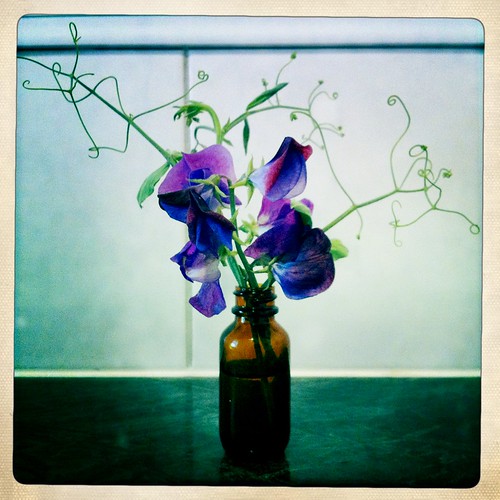
I have a couple of sweet pea plants in my plot at the moment and there's lots of sweetpeas going off their heads in some of the neighbouring plots as well. Next year, come spring, I might just take a leaf out of Robert's book and plant the plot with a wall to wall tangle of sweet pea fabulousness.


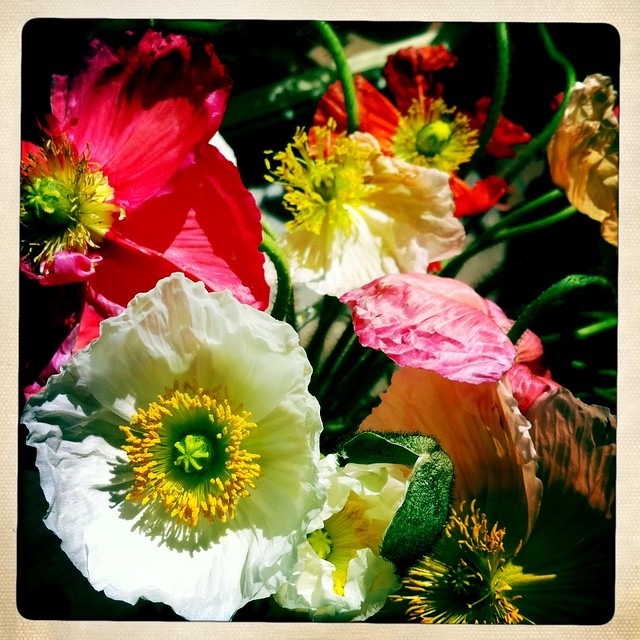
Anyway, the following photos are all of recent blooms.... a few of them are double ups. I think it's fascinating the way a bunch of flowers takes on a different character in different lights and I love the way they change over time. All of the flowers pictured were picked from the roadside or from my garden(s). The only exceptions being the last two photos, a bunch of glorious florist-bought poppies from my true love that I just couldn't resist including. Sigh.


M and F thought it was hilarious to pose beautifully with their posies for a moment, only to fall down shrieking with laughter every time I tried to take a photo. Turned out it was pretty funny. The posies didn't last long but plenty of fun was had by all.


xx

Poppy love.

Saturday, October 15, 2011

Broad Bean Lovin'


Broad beans are the thing in the garden at the moment, big clumps of them, tall and round-leafed, stand proudly in almost every plot. And my plot is no exception. Lize and I put some in at the start of winter and they’ve just started cropping. We picked the first beans on Friday and I was determined to show them off at a pot luck Sunday lunch. Down at the garden on Sunday morning, harvesting more beans I got chatting to Gavin and Amanda about cooking them. They brought up the slightly frustrating element of broad bean cookery, the fact that once you’re done shelling them and skinning them, your huge pile of beans becomes a surprisingly small handful of actual edible beans.

I got a reasonable haul from my plot but as I was making a dish to serve about 10 people, I decided to find a way to stretch my beans as far as possible. Combining them with a pasta salad seemed the obvious choice and I decided to avoid the broad bean law of diminishing returns by making sure I used as much of the bean as possible. This meant combining several recipes and cooking methods, a risky strategy for a Sunday show off luncheon but I think it paid off in the end.

My recipe ended up being a combination/bastardisation of a few different recipes and cooking suggestions. I served it on Sunday with the wonderfully wanky title (thanks Rylee!), Pasta with Broad Beans Three Ways. This didn’t sit quite right with me though (too Masterchef) so I decided to ratchet up the wank factor and rename it something a little more Frenchy and chic.  And so, ladies and gentleman, without further ado, I give you....


Broad Bean Ménage a Trois 

Basically everything gets made separately then combined with the cooked pasta at the end. It’s a little time consuming (took me about an hour and a half) perfect for Sunday lunch but maybe not for Monday night dinner.  The three different broad bean approaches are outlined below.

Part 1) Getting Smashed

This part of the recipe uses the larger beans (which need to be removed from their tough outer shells) in a bastardisation of the Moroccan Broad Bean Dip from Stephanie. Because the beans are cooked for longer than usual, the skin softens and can be left on, which means more bean for your buck.

I cooked the shelled beans in salted boiling water for 15 minutes, strained them (reserved the cooking water) and chucked them in mortar and pestle with lemon juice, a couple of cloves of garlic, salt, pepper, a little olive oil and a splash or two of the cooking water. Then I simply bashed them up until I had a chunky paste. I tasted it to check the seasoning, as luck would have it, mine turned out to be bang on... but you could always adjust as required.

Part 2) In the Raw

Jamie Oliver mentions in Jamie at Home that you can eat baby broad beans raw AND that the shoots are great in salads. I took him up on this and picked a bunch of bean tips, washed them and chopped them up with some sorrel. I also put aside the smaller sized beans when I was shelling them for the smash (above) and tossed these through the salad too.

Part 3) Long and Slow

This part formed the bulk of the beans in my salad. It uses the smaller beans and is a variation on Stephanie’s Andalucían recipe. Stephanie suggests only using beans less than 12cms – because of their smaller size (and the slow cooking process) they can be eaten pod and all, whoo!

So, I topped and tailed the broad beans (washed first) then cut them into segments, trying my best to cut between the individual beans not through them. If I’d had more garlic I would have cooked a little in oil first then added my beans to the fry pan. As it was I turned the beans in olive oil a couple of time before adding lemon juice, a dash of water, salt, pepper, bay and thyme (a dash of white wine and some lemon peel would also go nicely). When the whole thing began to simmer I tipped it into an oven proof dish popped on the lid and put it in the oven at 180 degrees C to cook slowly for an hour.

Bits on the Side

While my slow beans were cooking I put the fry pan back to use, first to cook up a batch of caramelised red onions (cook covered with a sprig of rosemary, a bay leaf and lots of oil for 15 mins, stirring often then uncover and cook further until they taste just right). When the onions were done I toasted a bunch of pine nuts, flaked almonds would also be good. I also shaved a whole lot of good quality parmesan to mix through.

I boiled the pasta (I used fancy fusilli), strained it, then chucked it back in the pot with the rest of the cooking water from the smashed beans. I let it sit for a few minute then strained off the excess water.

The Final Toss

Once the pasta has soaked in the cooking water, it'd be good to add the bean smash to mix it through well. I didn’t this time, in fact I forgot to mix in the smashed beans all together and only remembered to do so after a couple of bland-ish mouthfuls at the table. Could have been a disaster! Take home message - don't, whatever you do, forget the smashed beans.

Anyway, once the slow beans are done, all that remains is to assemble the salad. Toss everything together and garnish with a few extra shaves of Parmesan, a dash of lemon juice and olive oil if necessary, and a good sprinkle of pine nuts. Serve up and enjoy with good mates and good wine.


Saturday, October 8, 2011

Spring Rain

 Rain on the parsley,
Rain on the peas,
Rain on the broad beans,
And rain on me!

Spring rain finally arrived in Melbourne! It was a dry September and I was getting worried about heading into summer without a good spring soaking. But the rain has come and it's stayed around. It's raining as I write, "falling down like love" as the Go-Betweens sang.

Speaking of spring rain...the other week, Mum and I brought a whole lot of plants and headed down to the garden to give a spring overhaul. Because Mum was only here for a couple of days we couldn't be very flexible with our time and we ended up gardening in the middle of a thunderstorm. By the end of the afternoon we were soaked to the bone, covered in mud, and my nerves were shot from the proximity of the lightning and thunder (we were gardening under powerlines). 

The garden, however, was transformed: the soil was turned and fed and mulched, winter plants removed and composted, stepping stones relaid, baby lettuce, basil and coriander planted and most importantly the tomatoes in and staked, ready for summer. I discovered the joys of chopping up plants for the compost (like making a giant coleslaw) and I came to relish the satisfying smack of snail under boot. All in all, it was a wonderful afternoon and, I hope, a great start to the growing season!!